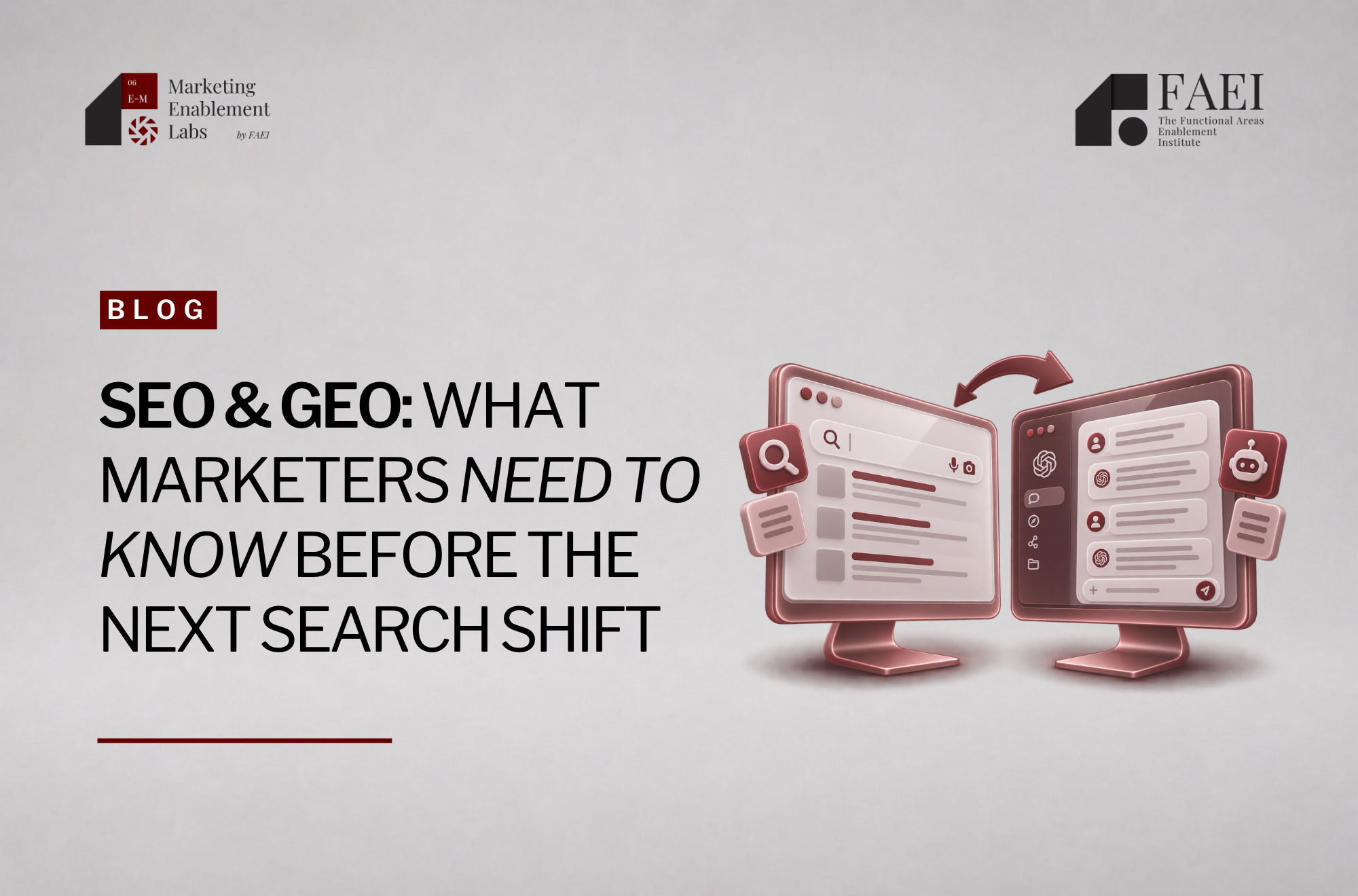
For nearly three decades, search engine optimization has followed one rule: rank high on Google, earn the click, drive the traffic. That rule is no longer the whole story. A growing share of people are skipping the search results page altogether and asking ChatGPT, Claude, or Gemini directly. That shift has created a new discipline: Generative Engine Optimization, or GEO.
If you work in marketing, understanding the difference between SEO and GEO, and why both now belong in the same strategy, is quickly becoming essential rather than optional.
What SEO Still Does
SEO optimizes content so it ranks in traditional search engine results pages. It relies on keywords, backlinks, site structure, and page authority to earn a position in a list of links that users then click through. This model has driven digital marketing for years, and it still matters. Most AI platforms still retrieve information from the open web, so a page that ranks well in Google remains more likely to get pulled into an AI-generated answer too.
What GEO Actually Means
GEO is the practice of structuring content so it gets cited, summarized, or referenced inside AI-generated answers, not just listed as a link. The term was coined in 2023 by researchers at Princeton, who published the first academic paper studying how content can be optimized for generative engines. Instead of competing for position on a results page, GEO competes for a place inside the answer itself.
The shift in goal is significant. SEO asks: how do we get someone to click through to our site? GEO asks: how do we get an AI system to name us, quote us, or build its answer around our information? The user may never visit your site at all, yet still walk away having been influenced by your brand because the AI referenced it directly.
Why This Is Happening Faster Than Expected
The numbers explain the urgency. Research from Gartner found that younger audiences are moving first: about 35% of Gen Z now uses AI tools as their first stop for research questions, compared to 19% of millennials and just 7% of Gen X. On the platform side, ChatGPT alone processes billions of prompts a day, and OpenAI has reported hundreds of millions of weekly active users, a scale that puts real pressure on how people discover brands.
Pew Research has also tracked what happens to click behavior once an AI summary appears at the top of a search. When it does, users click through to a traditional website in only about 8% of visits, compared to roughly 15% when no AI summary is shown. That gap represents traffic that used to land on business websites and now stays inside the AI conversation instead.
The relationship between ranking and being cited is also changing. Ahrefs tracked AI Overview citations in mid-2024 and found that about 76% came from pages already ranking in Google’s top 10 organic results. By 2026, that share had dropped to roughly 38%. In other words, ranking well used to be a reliable proxy for getting cited by AI. It no longer is. Pages that never crack the top 10 are now earning citations purely because of how clearly and credibly they present information.
What Actually Improves GEO Performance
A widely cited study from Princeton and Georgia Tech (Aggarwal et al., KDD 2024) tested which content changes actually move the needle inside AI-generated responses. Two findings stand out. Adding statistics to a page increased its visibility in AI answers by up to 40%. Adding credible citations and direct quotations increased visibility by up to 41%. Content that reads like a well-sourced reference document, rather than a persuasive sales page, performs noticeably better.
This points to a practical takeaway for marketers: AI systems favor content that looks and reads like evidence. That means naming real sources, including data points, answering questions directly and early, and writing in a way that a model could lift a sentence from without needing to reinterpret it.
SEO and GEO Are Not Competing Strategies
It is tempting to frame this as SEO versus GEO, but the more accurate picture is that GEO sits on top of SEO rather than replacing it. Most generative engines still rely on some form of retrieval from the existing web, so the technical fundamentals of SEO, like crawlability, site structure, and page authority, remain part of the foundation. GEO adds a second layer on top: making sure that once your content is retrieved, it is actually the piece the AI chooses to cite, quote, or summarize.
Brands that treat GEO as a one-time adjustment tend to lose ground quickly, because AI systems weigh recency heavily, especially for time-sensitive topics. Content published years ago without updates consistently loses visibility to newer material covering the same subject. GEO, like SEO before it, rewards a sustained habit of publishing accurate, updated, well-sourced content rather than a single optimization pass.
Where This Leaves Marketers
The takeaway is not that SEO is dying. It is that the definition of visibility has expanded. Being found now means two things at once: ranking where people still search, and being the source an AI chooses to speak on your behalf when they don’t. Marketers who build both into their content strategy from the start will be positioned for whichever way a given audience chooses to search, this year and beyond.
Want to build the strategic foundation to navigate shifts like this one? Our Certified Marketing Enablement Professional program is a five day live online certification that walks you through the full marketing lifecycle, from market research and brand strategy to planning and performance measurement, so you can adapt your marketing approach as the landscape keeps changing